exhibitions
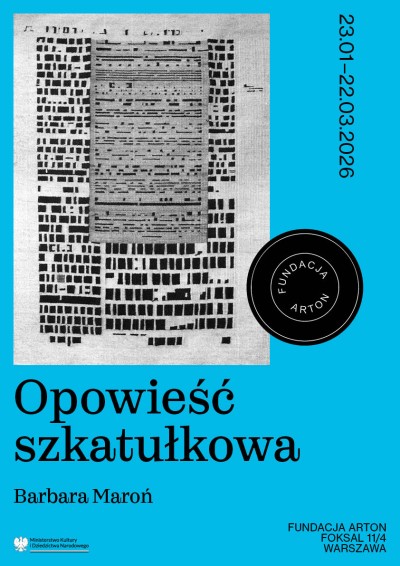
Barbara Maroń. A Story Within a Story
Barbara Maroń. A Story Within a Story
Arton Foundation
Foksal 11/4, Warsaw
Exhibition: 23 January–22 March 2026
Opening: 23 January 2026, 7 p.m.
Curator: Marika Kuźmicz
Collaboration: Dariusz Mikołajczak, Adam Parol
Film tour of the exhibition╰┈➤
Guided tour of the exhibition with the artist: 15 March 2026, 1:00 p.m.
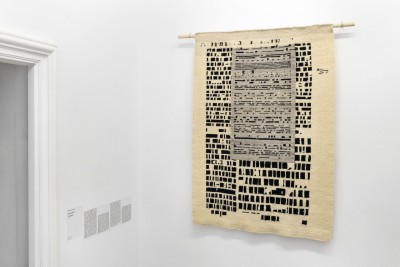
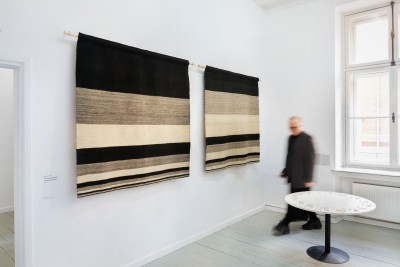
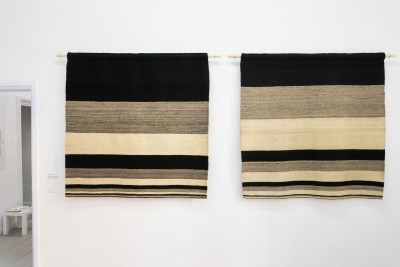
“By weaving, I construct an image – an object identical to the structure of the base; the unique structure of the fabric replaces the non-transparent texture of paint; form, color, and texture result from the interlacing of weft and warp, from left to right and from right to left, and from the structure of the finished fabric; the act of weaving resembles the act of reading and writing – simple rhythms form verses, creating orders analogous to handwriting, sketching, printing…” This statement by Barbara Maroń applies not only to her textiles, but to her artistic practice as such. Although her works take diverse forms – the aforementioned woven depictions, but also books and objects – they consistently revolve around text and the activities tied to its creation: writing and perceiving it, that is, reading.
Philosopher Vilém Flusser identified the invention of writing and the invention of photography as two pivotal moments in human history. He argued that, despite our confidence, we have never truly learned how to read photographic images. We tend to trust them instinctively, assuming they require no interpretation, which carries serious risks, particularly today, when they are increasingly generated artificially and only appear to be anchored in reality. Perhaps we need words now more than ever?
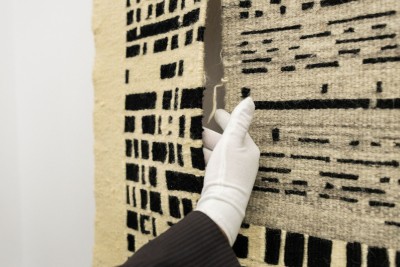
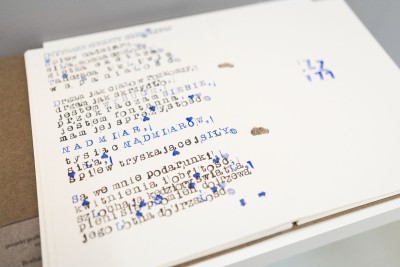
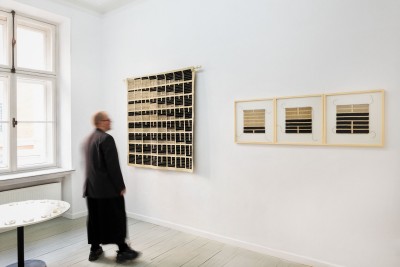
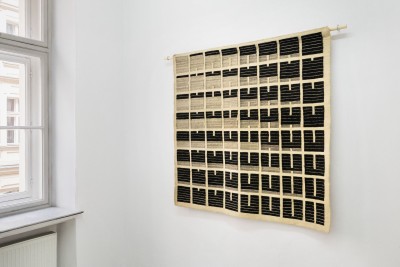
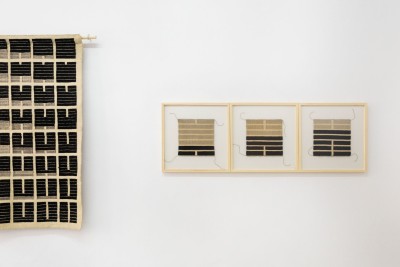
Barbara Maroń’s works mark a return to text. They direct our attention to language and its power, derived both from its communicative capacity and from the mystery it can conceal. Text can function as a clue, a path, an inspiration, or a labyrinth – and all of these qualities are revealed in the pieces presented at the Arton Foundation. This return to text is also tactile: the viewer is invited not only to see language, but to feel it, recalling the handwritten, linear process of its creation, closely aligned with the rhythms of human thought. In an era of pervasive distraction, this mode of thinking emerges as a precious yet vanishing resource.
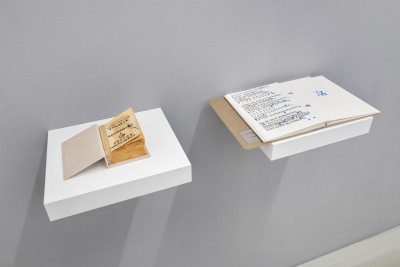
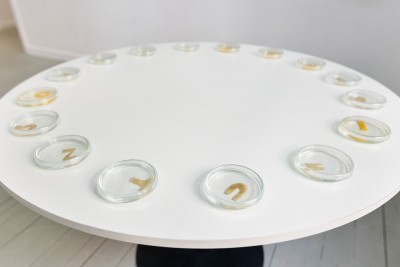
Maroń’s sequence of works also forms a narrative about stories and texts passed down through generations, and about secrets hidden in books. The exhibition’s structure resembles a story within a story: its fragments may be read individually or assembled into a multilayered narrative.
Barbara Maroń was born in Kraków in 1955. In the 1980s, she worked primarily in design and textile arts. From 1987 to 1989, she co-ran the “gt” Gallery at the Mandala Theater in Kraków. From the 1990s through the mid-2000s, she used primarily video and photography to create objects and installations, addressing questions of identification, self-identification, and image construction. She was a co-founder and member of the Fort Sztuki Association (1986–2006), participated in the program and organizational committee of the Fort Sztuki festivals (1994–2000), and served on the editorial board of Fort Sztuki magazine (2003–2005), while also initiating and inspiring numerous artistic events in Poland and abroad.
Her works have been presented in the Republic of Ireland (Cork), Northern Ireland (Belfast), and Canada, including exhibitions at Le Lieu, centre en art actuel, and the VU Photo Gallery in Québec City.
For over a decade, Maroń has explored the form of the artistic documentary, producing structurally complex video works as a cinematographer, director, and editor. These include Awangardy Wrocławia lat 60. i 70. XX wieku – śladami absolwentów Państwowej Wyższej Szkoły Sztuk Plastycznych [The Avant-Gardes of Wrocław in the 1960s and 1970s – In the Footsteps of Graduates of the State Higher School of Fine Arts] (2015), created in collaboration with the Department of Art Mediation at the Academy of Fine Arts in Wrocław as part of a research program on Wrocław conceptualism. In 2021, she completed Teatr mroku, przekory I uciechy [Theater of Darkness, Contradiction, and Joy] – a film essay devoted to the work of Joanna Braun, a renowned costume and set designer for dramatic and puppet theater. Her most recent project, premiering in February 2026, is the film study Pokazać słowo / Utwory ulotne [To Show the Word / Fleeting Works], focusing on the practice of Alicja Jodko – philosopher, visual poet, and co-founder (with Mariusz Jodko) and curator of the Entropia Gallery in Wrocław.
Subsidized by the Ministry of Culture and National Heritage from the Fund for Promotion of Culture.
Arton Foundation
Foksal 11/4, Warsaw
Exhibition: 23 January–22 March 2026
Opening: 23 January 2026, 7 p.m.
Curator: Marika Kuźmicz
Collaboration: Dariusz Mikołajczak, Adam Parol
Film tour of the exhibition╰┈➤
Guided tour of the exhibition with the artist: 15 March 2026, 1:00 p.m.
“By weaving, I construct an image – an object identical to the structure of the base; the unique structure of the fabric replaces the non-transparent texture of paint; form, color, and texture result from the interlacing of weft and warp, from left to right and from right to left, and from the structure of the finished fabric; the act of weaving resembles the act of reading and writing – simple rhythms form verses, creating orders analogous to handwriting, sketching, printing…” This statement by Barbara Maroń applies not only to her textiles, but to her artistic practice as such. Although her works take diverse forms – the aforementioned woven depictions, but also books and objects – they consistently revolve around text and the activities tied to its creation: writing and perceiving it, that is, reading.
Philosopher Vilém Flusser identified the invention of writing and the invention of photography as two pivotal moments in human history. He argued that, despite our confidence, we have never truly learned how to read photographic images. We tend to trust them instinctively, assuming they require no interpretation, which carries serious risks, particularly today, when they are increasingly generated artificially and only appear to be anchored in reality. Perhaps we need words now more than ever?
Barbara Maroń’s works mark a return to text. They direct our attention to language and its power, derived both from its communicative capacity and from the mystery it can conceal. Text can function as a clue, a path, an inspiration, or a labyrinth – and all of these qualities are revealed in the pieces presented at the Arton Foundation. This return to text is also tactile: the viewer is invited not only to see language, but to feel it, recalling the handwritten, linear process of its creation, closely aligned with the rhythms of human thought. In an era of pervasive distraction, this mode of thinking emerges as a precious yet vanishing resource.
Maroń’s sequence of works also forms a narrative about stories and texts passed down through generations, and about secrets hidden in books. The exhibition’s structure resembles a story within a story: its fragments may be read individually or assembled into a multilayered narrative.
Barbara Maroń was born in Kraków in 1955. In the 1980s, she worked primarily in design and textile arts. From 1987 to 1989, she co-ran the “gt” Gallery at the Mandala Theater in Kraków. From the 1990s through the mid-2000s, she used primarily video and photography to create objects and installations, addressing questions of identification, self-identification, and image construction. She was a co-founder and member of the Fort Sztuki Association (1986–2006), participated in the program and organizational committee of the Fort Sztuki festivals (1994–2000), and served on the editorial board of Fort Sztuki magazine (2003–2005), while also initiating and inspiring numerous artistic events in Poland and abroad.
Her works have been presented in the Republic of Ireland (Cork), Northern Ireland (Belfast), and Canada, including exhibitions at Le Lieu, centre en art actuel, and the VU Photo Gallery in Québec City.
For over a decade, Maroń has explored the form of the artistic documentary, producing structurally complex video works as a cinematographer, director, and editor. These include Awangardy Wrocławia lat 60. i 70. XX wieku – śladami absolwentów Państwowej Wyższej Szkoły Sztuk Plastycznych [The Avant-Gardes of Wrocław in the 1960s and 1970s – In the Footsteps of Graduates of the State Higher School of Fine Arts] (2015), created in collaboration with the Department of Art Mediation at the Academy of Fine Arts in Wrocław as part of a research program on Wrocław conceptualism. In 2021, she completed Teatr mroku, przekory I uciechy [Theater of Darkness, Contradiction, and Joy] – a film essay devoted to the work of Joanna Braun, a renowned costume and set designer for dramatic and puppet theater. Her most recent project, premiering in February 2026, is the film study Pokazać słowo / Utwory ulotne [To Show the Word / Fleeting Works], focusing on the practice of Alicja Jodko – philosopher, visual poet, and co-founder (with Mariusz Jodko) and curator of the Entropia Gallery in Wrocław.
Subsidized by the Ministry of Culture and National Heritage from the Fund for Promotion of Culture.
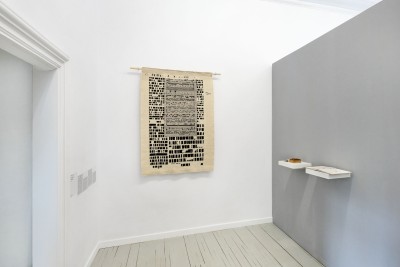
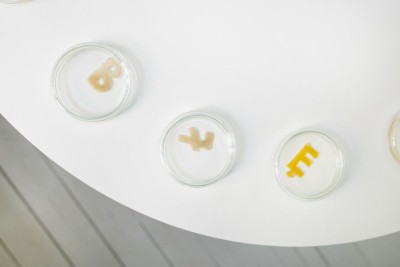
View of the exhibition "Barbara Maroń. A Story Within a Story"
Alexander Kot-Zaitsaŭ
Other exhibitions
-
 exhibitions
Natural Situations: Agnieszka Niziurska
-
 exhibitions
Parts. Zofia Glazer-Rudzińska
-
 exhibitions
Social History. 70 years of the gallery at Rynek Starego Miasta 2
-
 exhibitions
70th Anniversary of the Gallery at the Old Town Cultural Centre
-
 exhibitions
Such Was My Dream. Joanna Stańko
-
 exhibitions
Applied Herstories: Irena Huml
-
 exhibitions
Grown in Love: Liliana Mikołajewska-Jansen
-
 exhibitions
Mirrors and Screens: Małgorzata Potocka, Jagoda Kaloper
-
 exhibitions
Places for Deliberation. Barbara Kozłowska
-
 exhibitions
Małgorzata Rittersschild. The Lizard Means Short-Lived Happiness
-
 exhibitions
Beyond Documentation Imaginations Emerge. Anna and Krystian Jarnuszkiewicz
-
 exhibitions
Presence. Maria Michałowska
-
 exhibitions
Argentine Experiment: CAyC and CSSR
-
 exhibitions
Jolanta Owidzka. I Wouldn’t Dare Walk on a Work of Art
-
 exhibitions
Open Jagoda Przybylak Studio
-
 exhibitions
Jagoda Przybylak: "... must see"
-
 exhibitions
Maria Michałowska: At the End of This Road I Might Find a Mirror exhibition
-
 exhibitions
Looking Into The Sun. Hanna Orzechowska
-
 exhibitions
Motifs: Krystyna Szczepanowska-Miklaszewska
-
 exhibitions
You Will Hear When You See Me
-
 exhibitions
Jagoda Przybylak: “... must see”
-
 exhibitions
Ties and Threads: Herstories of Eleonora Plutyńska
-
 exhibitions
The less work, the better effect. Liliana Lewicka
-
 exhibitions
Anna Buczkowska
-
 exhibitions
Wspólny splot
-
 exhibitions
Hanna Orzechowska. W relacji / In relation
-
 exhibitions
wystawa Pawła Kwieka "Zrobić niemożliwe światło"
-
 exhibitions
Małgorzata Potocka
-
 exhibitions
P.S. Warunkiem uczestnictwa jest praca twórcza. Mikrohistorie plenerow w Osiekach
-
 exhibitions
Who is Janina Węgrzynowska?
-
 exhibitions
Anna Ciba: When You Look Into My Eyes, What Do You See?
-
 exhibitions
Małgorzata Potocka. We Don’t Need Other Words When We Have Mirrors
-
 exhibitions
Zdzisław Jurkiewicz. Sun in the Kitchen
-
 exhibitions
CLICK. Sexualisation of Food in Art
-
 exhibitions
Andrij Bojarov / Андрій Бояров: Koło i kula / Коло і куля
-
 exhibitions
Tapta
-
 exhibitions
Sisters: Alicja & Bożena Wahl
-
 exhibitions
Zdzisław Jurkiewicz. Occurrences
-
 exhibitions
Three Things I Love in Life: the Car, Liquor, and Sailors
-
 exhibitions
Phony Smile. Language of Aesthetic Speculation in Croatian Photography
-
 exhibitions
Exhibition Laboratory of Presentation Techniques
-
 exhibitions
Barbara Kozłowska. Linia
-
 exhibitions
Barbara Kozłowska. You Can See It All Anywhere
-
 exhibitions
Soft shooting? Introducing the History of Women’s Photography in Croatia
-
 exhibitions
Out in the Fresh Air? Early Ecological Projects during Artistic Plein-Airs in Poland
-
 exhibitions
At The Worlds Table. Zdzisław Jurkiewicz
-
 exhibitions
The Case of Jadwiga S.
-
 exhibitions
IN. Ludmiła Popiel i Jerzy Fedorowicz
-
 exhibitions
Womens Art, Iwona Lemke-Konart
-
 exhibitions
Paweł Kwiek. Time Difference
-
 exhibitions
Formy nikłe. Ludmiła Popiel & Jerzy Fedorowicz
-
 exhibitions
Nie mów, że urodziłeś się w złym czasie
-
 exhibitions
1: 11 Microstories
-
 exhibitions
I lay and fly away
-
 exhibitions
Wystawa Jolanty Marcolli w BWA Zielona Góra
-
 exhibitions
Ja to ktoś inny / Bruce Nauman / Krzysztof Niemczyk
-
 exhibitions
Video Killed The TV Star
-
 exhibitions
If you dont know me by now, you will never never never know me
-
 exhibitions
Arton Review Europe - exhibition and film screening
-
 exhibitions
Ludmiła Popiel
-
 exhibitions
Doing the Impossible Light
-
 exhibitions
Jolanta Marcolla. A Room of One’s Own
-
 exhibitions
across realities Wojciech Bruszewski / Mateusz Sadowski
-
 exhibitions
Andrzej Jórczak. Looking at Alpha Ursae
-
 exhibitions
6 meters before Paris - Eustachy Kossakowski
-
 exhibitions
Polska Fotografia Konceptualna
-
 exhibitions
Conceptualism. Photographic medium.
-
 exhibitions
Barbara Kozłowska Wszystko to możesz zobaczyć gdziekolwiek
-
 exhibitions
Zdarzenia. Zdzisław Jurkiewicz