exhibitions
wystawa Pawła Kwieka "Zrobić niemożliwe światło"
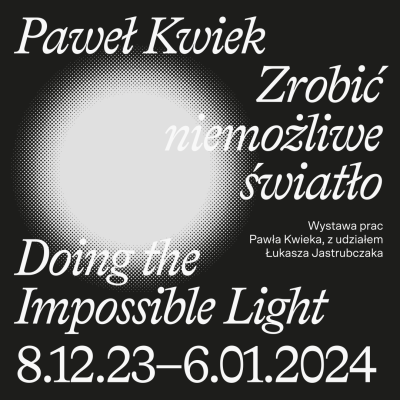
Paweł Kwiek
Doing the Impossible Light
Exhibition of works by Paweł Kwiek, with participation of Łukasz Jastrubczak
Opening: 8 December 2023, 7.00 p.m.
Exhibition: 9 December 2023–6 January 2024
Curator: Marika Kuźmicz
Collaboration: Adam Parol
Graphic design: Krzysztof Bielecki
Co-financed by the Ministry of Culture and National Heritage from the Culture Promotion Fund
You can see the 3D model of our exhibtion:
https://wnetrza3d.pl/realizacje/fundacja-arton/zrobic-niemozliwe-swiatlo-wystawa-prac-6218/
Please join the guided tour:
https://youtu.be/rGCUoTvws2I
Paweł Kwiek (16 March 1951–13 March 2022) worked in virtually all media: he used film, he was a forerunner of video art in Poland, a photographer, performer, and he also worked in painting, drawing and sculpture. He switched between his artistic tools with ease, never losing sight of what was most important to him.
Who was he? He graduated from the Film School in Łódź (1969–1974), where he co-created the legendary Workshop of the Film Form group (1970–1978) and taught at the school (until 1981). He also lectured at the Academy of Fine Arts in Warsaw (1974–1976).
In the 1970s, he was very actively involved in the Polish neo-avant-garde milieu, creating 35 mm films as well as video works and photographs. These have been usually described as conceptual or structural works, although it was already apparent at the time that Kwiek’s creative interests went beyond the then-current canon of issues most often addressed in art. Most of his works of the time were concerned with interpersonal communication, particularly with trying to reach understanding despite different points of view. This became even more evident around 1978, when the Workshop of the Film Form practically suspended its activities. It was at that time that Kwiek created works such as Video and Breath, Information Channel, Perception of the Lack of Differentiation or The Inter-Drawings Table.
Shortly afterwards, in 1980, an event that the artist described as “the key experience of his life” took place. During a long meditation (he was deeply engaged in yoga and breathing exercises at the time), he saw before him an unusual golden light, which was in constant motion yet remained calm and emanated love. This experience caused Kwiek to revise his hitherto rational – as he said himself – worldview and turn towards the sphere of spirituality, opening himself up to others and to metaphysical experiences.
At the beginning of the 1980s, he suffered a severe nervous breakdown, which triggered a series of hospitalisations. The rhythm of his life began to be marked by relapses of paranoid schizophrenia, interspersed by periods of recovery. He always spoke openly about his illness, treating it as a part of his life and trying to explain this experience to others. Despite many years of poor financial situation and deteriorating health, he was creatively active practically until the end of his life.
His works from the 1980s and 1990s are a remarkable record of his encounters with others and his own spiritual experiences. In 2010, he carried out the still relevant action Three Days Without War, in which he called on world leaders to unconditionally cease hostilities. Towards the end of his life, he wrote a lot, mainly working on his diaries and creating poems, but he also prepared special photo albums that showed his everyday struggles.
The exhibition Doing the Impossible Light is the first presentation of Paweł Kwiek’s oeuvre after his death. Choosing the exhibits without him was not easy – the artist always wanted to be involved in the preparations for his shows.
We wanted to present this extraordinary, long-term creative process in which Paweł Kwiek was often uncompromising, striving to learn as much as possible about the world and the people he met. What links Paweł's early works and his later projects is that they were his tools for establishing communication and understanding, as well as instruments for discovering himself through others. And vice versa.
Doing the Impossible Light
Exhibition of works by Paweł Kwiek, with participation of Łukasz Jastrubczak
Opening: 8 December 2023, 7.00 p.m.
Exhibition: 9 December 2023–6 January 2024
Curator: Marika Kuźmicz
Collaboration: Adam Parol
Graphic design: Krzysztof Bielecki
Co-financed by the Ministry of Culture and National Heritage from the Culture Promotion Fund
You can see the 3D model of our exhibtion:
https://wnetrza3d.pl/realizacje/fundacja-arton/zrobic-niemozliwe-swiatlo-wystawa-prac-6218/
Please join the guided tour:
https://youtu.be/rGCUoTvws2I
Paweł Kwiek (16 March 1951–13 March 2022) worked in virtually all media: he used film, he was a forerunner of video art in Poland, a photographer, performer, and he also worked in painting, drawing and sculpture. He switched between his artistic tools with ease, never losing sight of what was most important to him.
Who was he? He graduated from the Film School in Łódź (1969–1974), where he co-created the legendary Workshop of the Film Form group (1970–1978) and taught at the school (until 1981). He also lectured at the Academy of Fine Arts in Warsaw (1974–1976).
In the 1970s, he was very actively involved in the Polish neo-avant-garde milieu, creating 35 mm films as well as video works and photographs. These have been usually described as conceptual or structural works, although it was already apparent at the time that Kwiek’s creative interests went beyond the then-current canon of issues most often addressed in art. Most of his works of the time were concerned with interpersonal communication, particularly with trying to reach understanding despite different points of view. This became even more evident around 1978, when the Workshop of the Film Form practically suspended its activities. It was at that time that Kwiek created works such as Video and Breath, Information Channel, Perception of the Lack of Differentiation or The Inter-Drawings Table.
Shortly afterwards, in 1980, an event that the artist described as “the key experience of his life” took place. During a long meditation (he was deeply engaged in yoga and breathing exercises at the time), he saw before him an unusual golden light, which was in constant motion yet remained calm and emanated love. This experience caused Kwiek to revise his hitherto rational – as he said himself – worldview and turn towards the sphere of spirituality, opening himself up to others and to metaphysical experiences.
At the beginning of the 1980s, he suffered a severe nervous breakdown, which triggered a series of hospitalisations. The rhythm of his life began to be marked by relapses of paranoid schizophrenia, interspersed by periods of recovery. He always spoke openly about his illness, treating it as a part of his life and trying to explain this experience to others. Despite many years of poor financial situation and deteriorating health, he was creatively active practically until the end of his life.
His works from the 1980s and 1990s are a remarkable record of his encounters with others and his own spiritual experiences. In 2010, he carried out the still relevant action Three Days Without War, in which he called on world leaders to unconditionally cease hostilities. Towards the end of his life, he wrote a lot, mainly working on his diaries and creating poems, but he also prepared special photo albums that showed his everyday struggles.
The exhibition Doing the Impossible Light is the first presentation of Paweł Kwiek’s oeuvre after his death. Choosing the exhibits without him was not easy – the artist always wanted to be involved in the preparations for his shows.
We wanted to present this extraordinary, long-term creative process in which Paweł Kwiek was often uncompromising, striving to learn as much as possible about the world and the people he met. What links Paweł's early works and his later projects is that they were his tools for establishing communication and understanding, as well as instruments for discovering himself through others. And vice versa.
Other exhibitions
-
 exhibitions
Natural Situations: Agnieszka Niziurska
-
 exhibitions
Parts. Zofia Glazer-Rudzińska
-
 exhibitions
Social History. 70 years of the gallery at Rynek Starego Miasta 2
-
 exhibitions
70th Anniversary of the Gallery at the Old Town Cultural Centre
-
 exhibitions
Such Was My Dream. Joanna Stańko
-
 exhibitions
Barbara Maroń. A Story Within a Story
-
 exhibitions
Applied Herstories: Irena Huml
-
 exhibitions
Grown in Love: Liliana Mikołajewska-Jansen
-
 exhibitions
Mirrors and Screens: Małgorzata Potocka, Jagoda Kaloper
-
 exhibitions
Places for Deliberation. Barbara Kozłowska
-
 exhibitions
Małgorzata Rittersschild. The Lizard Means Short-Lived Happiness
-
 exhibitions
Beyond Documentation Imaginations Emerge. Anna and Krystian Jarnuszkiewicz
-
 exhibitions
Presence. Maria Michałowska
-
 exhibitions
Argentine Experiment: CAyC and CSSR
-
 exhibitions
Jolanta Owidzka. I Wouldn’t Dare Walk on a Work of Art
-
 exhibitions
Open Jagoda Przybylak Studio
-
 exhibitions
Jagoda Przybylak: "... must see"
-
 exhibitions
Maria Michałowska: At the End of This Road I Might Find a Mirror exhibition
-
 exhibitions
Looking Into The Sun. Hanna Orzechowska
-
 exhibitions
Motifs: Krystyna Szczepanowska-Miklaszewska
-
 exhibitions
You Will Hear When You See Me
-
 exhibitions
Jagoda Przybylak: “... must see”
-
 exhibitions
Ties and Threads: Herstories of Eleonora Plutyńska
-
 exhibitions
The less work, the better effect. Liliana Lewicka
-
 exhibitions
Anna Buczkowska
-
 exhibitions
Wspólny splot
-
 exhibitions
Hanna Orzechowska. W relacji / In relation
-
 exhibitions
Małgorzata Potocka
-
 exhibitions
P.S. Warunkiem uczestnictwa jest praca twórcza. Mikrohistorie plenerow w Osiekach
-
 exhibitions
Who is Janina Węgrzynowska?
-
 exhibitions
Anna Ciba: When You Look Into My Eyes, What Do You See?
-
 exhibitions
Małgorzata Potocka. We Don’t Need Other Words When We Have Mirrors
-
 exhibitions
Zdzisław Jurkiewicz. Sun in the Kitchen
-
 exhibitions
CLICK. Sexualisation of Food in Art
-
 exhibitions
Andrij Bojarov / Андрій Бояров: Koło i kula / Коло і куля
-
 exhibitions
Tapta
-
 exhibitions
Sisters: Alicja & Bożena Wahl
-
 exhibitions
Zdzisław Jurkiewicz. Occurrences
-
 exhibitions
Three Things I Love in Life: the Car, Liquor, and Sailors
-
 exhibitions
Phony Smile. Language of Aesthetic Speculation in Croatian Photography
-
 exhibitions
Exhibition Laboratory of Presentation Techniques
-
 exhibitions
Barbara Kozłowska. Linia
-
 exhibitions
Barbara Kozłowska. You Can See It All Anywhere
-
 exhibitions
Soft shooting? Introducing the History of Women’s Photography in Croatia
-
 exhibitions
Out in the Fresh Air? Early Ecological Projects during Artistic Plein-Airs in Poland
-
 exhibitions
At The Worlds Table. Zdzisław Jurkiewicz
-
 exhibitions
The Case of Jadwiga S.
-
 exhibitions
IN. Ludmiła Popiel i Jerzy Fedorowicz
-
 exhibitions
Womens Art, Iwona Lemke-Konart
-
 exhibitions
Paweł Kwiek. Time Difference
-
 exhibitions
Formy nikłe. Ludmiła Popiel & Jerzy Fedorowicz
-
 exhibitions
Nie mów, że urodziłeś się w złym czasie
-
 exhibitions
1: 11 Microstories
-
 exhibitions
I lay and fly away
-
 exhibitions
Wystawa Jolanty Marcolli w BWA Zielona Góra
-
 exhibitions
Ja to ktoś inny / Bruce Nauman / Krzysztof Niemczyk
-
 exhibitions
Video Killed The TV Star
-
 exhibitions
If you dont know me by now, you will never never never know me
-
 exhibitions
Arton Review Europe - exhibition and film screening
-
 exhibitions
Ludmiła Popiel
-
 exhibitions
Doing the Impossible Light
-
 exhibitions
Jolanta Marcolla. A Room of One’s Own
-
 exhibitions
across realities Wojciech Bruszewski / Mateusz Sadowski
-
 exhibitions
Andrzej Jórczak. Looking at Alpha Ursae
-
 exhibitions
6 meters before Paris - Eustachy Kossakowski
-
 exhibitions
Polska Fotografia Konceptualna
-
 exhibitions
Conceptualism. Photographic medium.
-
 exhibitions
Barbara Kozłowska Wszystko to możesz zobaczyć gdziekolwiek
-
 exhibitions
Zdarzenia. Zdzisław Jurkiewicz