exhibitions
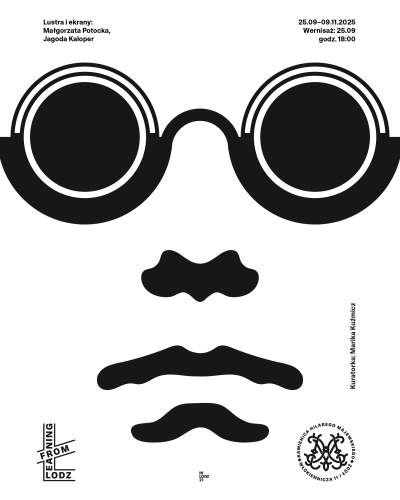
Mirrors and Screens: Małgorzata Potocka, Jagoda Kaloper
Mirrors and Screens: Małgorzata Potocka, Jagoda Kaloper
exhibition curated by Marika Kuźmicz, president of the Arton Foundation
Villa of Hilary Majewski
(Kamienica Hilarego Majewskiego)
Ul. Włókiennicza 11, Łódź
25 September–09 November 2025
opening: 25 September 2025, 6 p.m.
Curator-led tour: 19 October 2025, 1 p.m.
Production: Magda Milewska
Communications: Kinga Stec, Maja Wójcik
Education: Ada Słowikowska, Maria Wasińska-Stelmaszczyk
Exhibition installation: Adam Mąka, Serhij Sokurenko
The exhibition Mirrors and Screens brings together Małgorzata Potocka (b. 1953) and Jagoda Kaloper (1947–2016). Although their education and career paths differed, both became well-known film actresses as well as visual artists.
Małgorzata Potocka has been connected with film for nearly her entire life. She played her first role as a child, then as a teenager, before graduating from the Acting Department of the Łódź Film School. While working on successive film roles, she also pursued visual art. At the end of the 1970s, together with her husband, Józef Robakowski, she ran an independent art space—the legendary Galeria Wymiany in Łódź–while co-creating the milieu of the Polish avant-garde of that period. She was among the first artists in Poland to use film and video as a medium, with photography also occupying a special place in her practice.
Jagoda Kaloper made her screen debut at the age of eighteen and went on to pursue a successful acting career, despite not having formal training in the field. In 1970 she graduated from the Academy of Fine Arts in Zagreb and subsequently held numerous solo exhibitions and took part in the most important group shows in Yugoslavia. Her first solo presentation, Neimenovani ambijent (Unnamed Environment), was shown at the SC Gallery. The artist covered the gallery’s floor with gray concrete slabs, leaving a depression in the middle, and placed a thin red neon line along one wall, stretching it from the interior toward the exit. The exhibition marked the beginning of Kaloper’s interest in non-institutional practices, interventions in public space, and the relationship between space and the artwork.
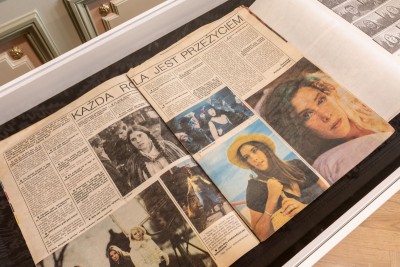
Despite numerous exhibitions and works created, both Potocka’s and Kaloper’s artistic output remained overshadowed for many years by their acting careers. The fame and recognition they gained from their popular film roles–and the fact of being identified with the characters they played on screen–shaped their art in different ways.
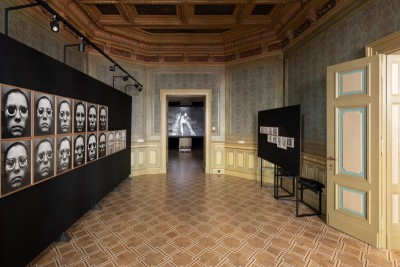
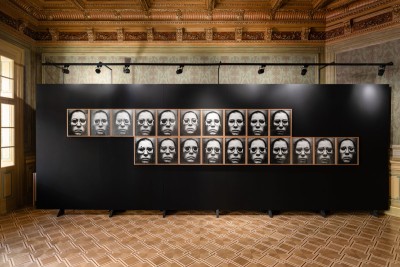
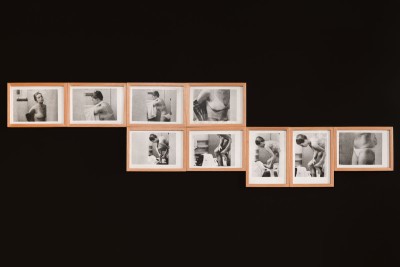
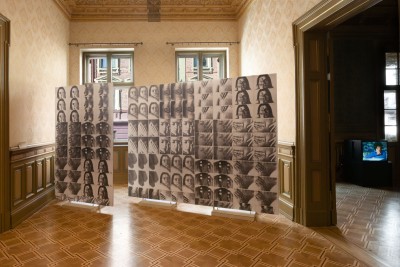
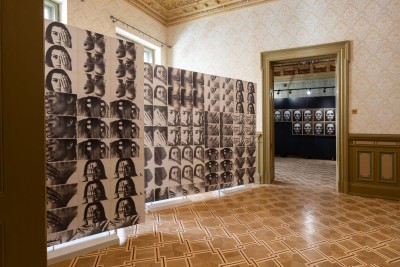
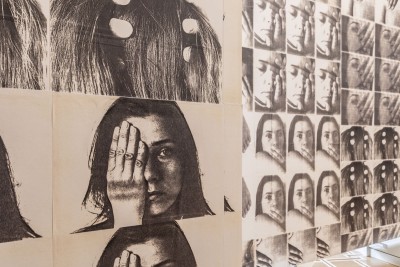
Much of Małgorzata Potocka’s work is a dialogue with her own image, with self-portrait becoming one of her key motifs. The series presented in this exhibition are various attempts to confront the image of her own body. Notebook (1979) is a series of photographs taken on the set of a Czechoslovak film. The character played by Potocka was spied upon in the locker room by her coach. The photos of the actress changing clothes also appear to have been taken in secret, reflecting an obsession that cannot be fulfilled. A slightly later series, Corrections (1981), consists of shots of the artist’s face, taken in an optician’s office while she tried on various corrective lenses used for eye examinations, each altering her field of vision. In this way, she gave deeper meaning to the dialogue between artist and viewer, compelling the audience to imagine how the world changes depending on shifts in perspective. Such a change may be artificially imposed or chosen by us. What do we see then, above all? What do we believe? What can we escape from by artificially manipulating our field of vision—and what do we want at all costs to see? In this work, Potocka also dedicates herself to the act of looking, as opposed to the role she so often assumed as an actress: that of being looked at.
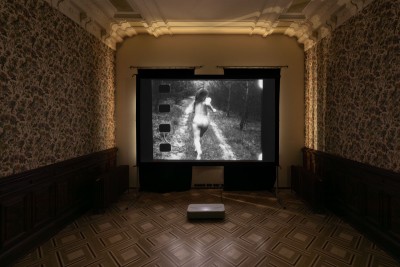
In the series Escapes (1982, created on film stock that has not survived), we see the naked artist running frantically forward. It is the image of someone fleeing, terrified, desperate to break free from a situation they find themselves in. This may be read as a metaphor for Poland’s increasingly difficult political situation at the time (the work was made shortly before martial law was introduced) or as a reference to Potocka’s personal situation–her wish to focus on creating her own works while stepping back from acting.
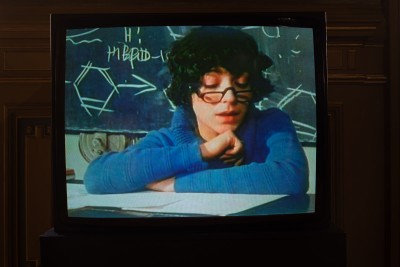
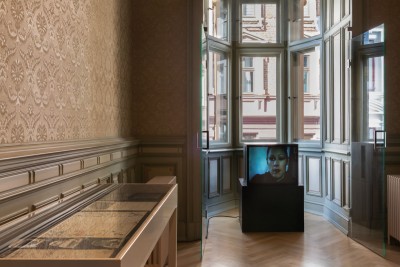
Jagoda Kaloper, on the other hand, summed up her acting career in 2011, when she directed her only film, Žena u ogledalu (Woman in the Mirror). It is a collage composed of various shots of her face from feature films in which she appeared. This work is both a reflection on the two intertwined paths of her creative life and perhaps also an attempt to confront the passage of time and the transformations we all undergo–transformations that are all the more difficult to accept when one’s appearance is subject to constant evaluation by strangers, as is the case for public figures.
The exhibition is above all an opportunity to consider similarities and differences in the ways both artists approached their own physicality and the functioning of their image in the media and public sphere. At the same time, it is an important contribution to contemporary discourse, in a reality increasingly dominated by social media, which have radically reshaped the meanings of concepts such as fame, popularity, role, image, corporeality, and privacy.
Więcej informacji znajdą Państwa na stronie Kamienicy Hilarego Majewskiego
exhibition curated by Marika Kuźmicz, president of the Arton Foundation
Villa of Hilary Majewski
(Kamienica Hilarego Majewskiego)
Ul. Włókiennicza 11, Łódź
25 September–09 November 2025
opening: 25 September 2025, 6 p.m.
Curator-led tour: 19 October 2025, 1 p.m.
Production: Magda Milewska
Communications: Kinga Stec, Maja Wójcik
Education: Ada Słowikowska, Maria Wasińska-Stelmaszczyk
Exhibition installation: Adam Mąka, Serhij Sokurenko
The exhibition Mirrors and Screens brings together Małgorzata Potocka (b. 1953) and Jagoda Kaloper (1947–2016). Although their education and career paths differed, both became well-known film actresses as well as visual artists.
Małgorzata Potocka has been connected with film for nearly her entire life. She played her first role as a child, then as a teenager, before graduating from the Acting Department of the Łódź Film School. While working on successive film roles, she also pursued visual art. At the end of the 1970s, together with her husband, Józef Robakowski, she ran an independent art space—the legendary Galeria Wymiany in Łódź–while co-creating the milieu of the Polish avant-garde of that period. She was among the first artists in Poland to use film and video as a medium, with photography also occupying a special place in her practice.
Jagoda Kaloper made her screen debut at the age of eighteen and went on to pursue a successful acting career, despite not having formal training in the field. In 1970 she graduated from the Academy of Fine Arts in Zagreb and subsequently held numerous solo exhibitions and took part in the most important group shows in Yugoslavia. Her first solo presentation, Neimenovani ambijent (Unnamed Environment), was shown at the SC Gallery. The artist covered the gallery’s floor with gray concrete slabs, leaving a depression in the middle, and placed a thin red neon line along one wall, stretching it from the interior toward the exit. The exhibition marked the beginning of Kaloper’s interest in non-institutional practices, interventions in public space, and the relationship between space and the artwork.
Despite numerous exhibitions and works created, both Potocka’s and Kaloper’s artistic output remained overshadowed for many years by their acting careers. The fame and recognition they gained from their popular film roles–and the fact of being identified with the characters they played on screen–shaped their art in different ways.
Much of Małgorzata Potocka’s work is a dialogue with her own image, with self-portrait becoming one of her key motifs. The series presented in this exhibition are various attempts to confront the image of her own body. Notebook (1979) is a series of photographs taken on the set of a Czechoslovak film. The character played by Potocka was spied upon in the locker room by her coach. The photos of the actress changing clothes also appear to have been taken in secret, reflecting an obsession that cannot be fulfilled. A slightly later series, Corrections (1981), consists of shots of the artist’s face, taken in an optician’s office while she tried on various corrective lenses used for eye examinations, each altering her field of vision. In this way, she gave deeper meaning to the dialogue between artist and viewer, compelling the audience to imagine how the world changes depending on shifts in perspective. Such a change may be artificially imposed or chosen by us. What do we see then, above all? What do we believe? What can we escape from by artificially manipulating our field of vision—and what do we want at all costs to see? In this work, Potocka also dedicates herself to the act of looking, as opposed to the role she so often assumed as an actress: that of being looked at.
In the series Escapes (1982, created on film stock that has not survived), we see the naked artist running frantically forward. It is the image of someone fleeing, terrified, desperate to break free from a situation they find themselves in. This may be read as a metaphor for Poland’s increasingly difficult political situation at the time (the work was made shortly before martial law was introduced) or as a reference to Potocka’s personal situation–her wish to focus on creating her own works while stepping back from acting.
Jagoda Kaloper, on the other hand, summed up her acting career in 2011, when she directed her only film, Žena u ogledalu (Woman in the Mirror). It is a collage composed of various shots of her face from feature films in which she appeared. This work is both a reflection on the two intertwined paths of her creative life and perhaps also an attempt to confront the passage of time and the transformations we all undergo–transformations that are all the more difficult to accept when one’s appearance is subject to constant evaluation by strangers, as is the case for public figures.
The exhibition is above all an opportunity to consider similarities and differences in the ways both artists approached their own physicality and the functioning of their image in the media and public sphere. At the same time, it is an important contribution to contemporary discourse, in a reality increasingly dominated by social media, which have radically reshaped the meanings of concepts such as fame, popularity, role, image, corporeality, and privacy.
Więcej informacji znajdą Państwa na stronie Kamienicy Hilarego Majewskiego
Widoki wystawy „Lustra i ekrany: Małgorzata Potocka, Jagoda Kaloper”
Anna Zagrodzka, dzięki uprzejmości Kamienicy Hilarego Majewskiego
Other exhibitions
-
 exhibitions
Natural Situations: Agnieszka Niziurska
-
 exhibitions
Parts. Zofia Glazer-Rudzińska
-
 exhibitions
Social History. 70 years of the gallery at Rynek Starego Miasta 2
-
 exhibitions
70th Anniversary of the Gallery at the Old Town Cultural Centre
-
 exhibitions
Such Was My Dream. Joanna Stańko
-
 exhibitions
Barbara Maroń. A Story Within a Story
-
 exhibitions
Applied Herstories: Irena Huml
-
 exhibitions
Grown in Love: Liliana Mikołajewska-Jansen
-
 exhibitions
Places for Deliberation. Barbara Kozłowska
-
 exhibitions
Małgorzata Rittersschild. The Lizard Means Short-Lived Happiness
-
 exhibitions
Beyond Documentation Imaginations Emerge. Anna and Krystian Jarnuszkiewicz
-
 exhibitions
Presence. Maria Michałowska
-
 exhibitions
Argentine Experiment: CAyC and CSSR
-
 exhibitions
Jolanta Owidzka. I Wouldn’t Dare Walk on a Work of Art
-
 exhibitions
Open Jagoda Przybylak Studio
-
 exhibitions
Jagoda Przybylak: "... must see"
-
 exhibitions
Maria Michałowska: At the End of This Road I Might Find a Mirror exhibition
-
 exhibitions
Looking Into The Sun. Hanna Orzechowska
-
 exhibitions
Motifs: Krystyna Szczepanowska-Miklaszewska
-
 exhibitions
You Will Hear When You See Me
-
 exhibitions
Jagoda Przybylak: “... must see”
-
 exhibitions
Ties and Threads: Herstories of Eleonora Plutyńska
-
 exhibitions
The less work, the better effect. Liliana Lewicka
-
 exhibitions
Anna Buczkowska
-
 exhibitions
Wspólny splot
-
 exhibitions
Hanna Orzechowska. W relacji / In relation
-
 exhibitions
wystawa Pawła Kwieka "Zrobić niemożliwe światło"
-
 exhibitions
Małgorzata Potocka
-
 exhibitions
P.S. Warunkiem uczestnictwa jest praca twórcza. Mikrohistorie plenerow w Osiekach
-
 exhibitions
Who is Janina Węgrzynowska?
-
 exhibitions
Anna Ciba: When You Look Into My Eyes, What Do You See?
-
 exhibitions
Małgorzata Potocka. We Don’t Need Other Words When We Have Mirrors
-
 exhibitions
Zdzisław Jurkiewicz. Sun in the Kitchen
-
 exhibitions
CLICK. Sexualisation of Food in Art
-
 exhibitions
Andrij Bojarov / Андрій Бояров: Koło i kula / Коло і куля
-
 exhibitions
Tapta
-
 exhibitions
Sisters: Alicja & Bożena Wahl
-
 exhibitions
Zdzisław Jurkiewicz. Occurrences
-
 exhibitions
Three Things I Love in Life: the Car, Liquor, and Sailors
-
 exhibitions
Phony Smile. Language of Aesthetic Speculation in Croatian Photography
-
 exhibitions
Exhibition Laboratory of Presentation Techniques
-
 exhibitions
Barbara Kozłowska. Linia
-
 exhibitions
Barbara Kozłowska. You Can See It All Anywhere
-
 exhibitions
Soft shooting? Introducing the History of Women’s Photography in Croatia
-
 exhibitions
Out in the Fresh Air? Early Ecological Projects during Artistic Plein-Airs in Poland
-
 exhibitions
At The Worlds Table. Zdzisław Jurkiewicz
-
 exhibitions
The Case of Jadwiga S.
-
 exhibitions
IN. Ludmiła Popiel i Jerzy Fedorowicz
-
 exhibitions
Womens Art, Iwona Lemke-Konart
-
 exhibitions
Paweł Kwiek. Time Difference
-
 exhibitions
Formy nikłe. Ludmiła Popiel & Jerzy Fedorowicz
-
 exhibitions
Nie mów, że urodziłeś się w złym czasie
-
 exhibitions
1: 11 Microstories
-
 exhibitions
I lay and fly away
-
 exhibitions
Wystawa Jolanty Marcolli w BWA Zielona Góra
-
 exhibitions
Ja to ktoś inny / Bruce Nauman / Krzysztof Niemczyk
-
 exhibitions
Video Killed The TV Star
-
 exhibitions
If you dont know me by now, you will never never never know me
-
 exhibitions
Arton Review Europe - exhibition and film screening
-
 exhibitions
Ludmiła Popiel
-
 exhibitions
Doing the Impossible Light
-
 exhibitions
Jolanta Marcolla. A Room of One’s Own
-
 exhibitions
across realities Wojciech Bruszewski / Mateusz Sadowski
-
 exhibitions
Andrzej Jórczak. Looking at Alpha Ursae
-
 exhibitions
6 meters before Paris - Eustachy Kossakowski
-
 exhibitions
Polska Fotografia Konceptualna
-
 exhibitions
Conceptualism. Photographic medium.
-
 exhibitions
Barbara Kozłowska Wszystko to możesz zobaczyć gdziekolwiek
-
 exhibitions
Zdarzenia. Zdzisław Jurkiewicz