exhibitions
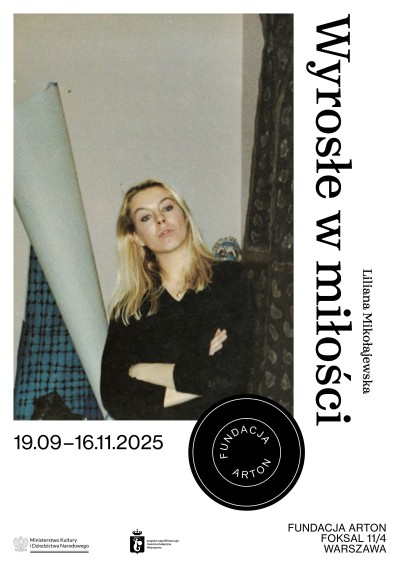
Grown in Love: Liliana Mikołajewska-Jansen
Grown in Love: Liliana Mikołajewska-Jansen
Arton Foundation
Foksal 11/4, Warsaw
19 September–16 November 2025
Opening: 19 September 2025, 7 p.m.
Curator: Marika Kuźmicz
Collaboration: Adam Parol
Film tour of the exhibition╰┈➤
Guided tour: 17 October 2025, 6 p.m.
We do not really know in what, or out of what, Liliana Mikołajewska’s works grew. The title of this exhibition – the first in nearly four decades – is inspired by one of her series of graphic works. Beyond that, she seldom titled her pieces. She left behind no written reflections; no interviews were conducted with her, or at least none survive. She died at an age when, for most artists, the journey has only just begun. The works she created during her student years constitute her entire oeuvre, and it is from these alone that we may attempt to decipher her intentions, inspirations, and creative impulses. Her biography is brief. She married early, began her studies at the Academy of Fine Arts in Warsaw, and interrupted them soon afterwards when she left Poland for Belgium in 1975. There she resumed her education, ultimately graduating from the Academy of Fine Arts in Ghent in 1980. Her life was cut short in a car accident.
What more can we say? With a high degree of certainty, she was determined to create and to pursue an original artistic path. This is evidenced both by the number of her works and by her persistence in continuing her studies under challenging circumstances: in a foreign country, in a foreign language, and in a world still divided by the Iron Curtain. In a sense, this makes the task of preparing her exhibition easier – we may assume she would have wanted her works to be seen again. Following Mikołajewska’s tragic death, only two major exhibitions of her oeuvre were held, presenting virtually her entire output. Importantly, they took place in two of the most important Polish institutions for contemporary art at the time: the CBWA Zachęta in Warsaw and Muzeum Sztuki in Łódź. Thereafter, her works disappeared from public view. The catalogue accompanying the Zachęta exhibition, although impressive in form, contains very little beyond reproductions of her works, a brief biography, and a memoir by her husband, Peter Jansen, who himself died tragically only a few years later. Other members of her family, who might have remembered her and spoken about her working process, her aspirations, and her inspirations, are also gone. What remains are the recollections of her school friends in Warsaw or her lecturer Wim Van Mulders – precious, though often shaped by emotion, impression, and subjective memory, and therefore not always easy to verify.
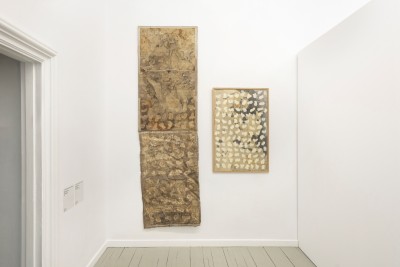
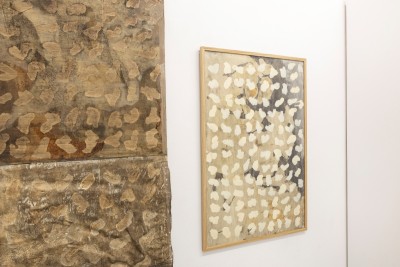
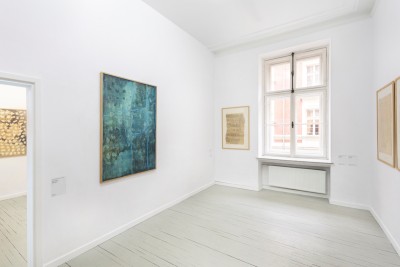
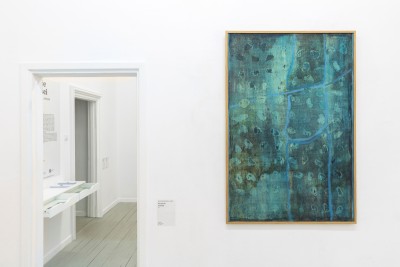
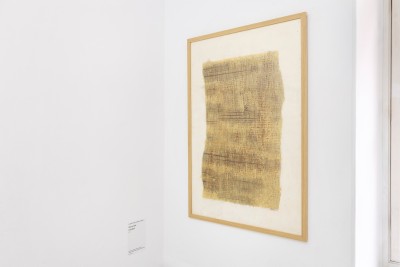
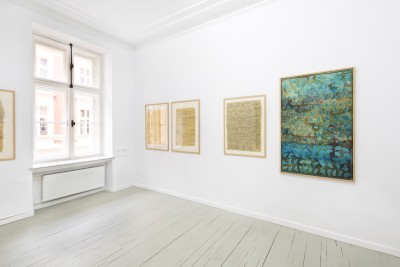
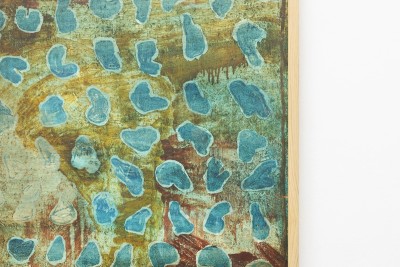
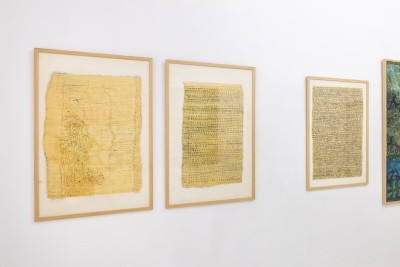
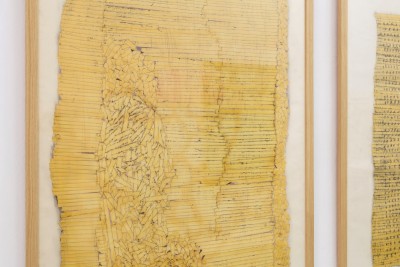
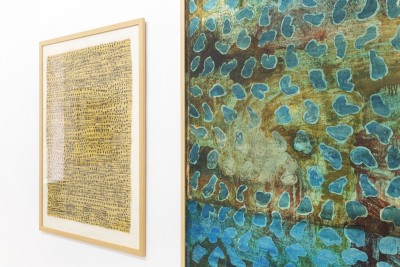
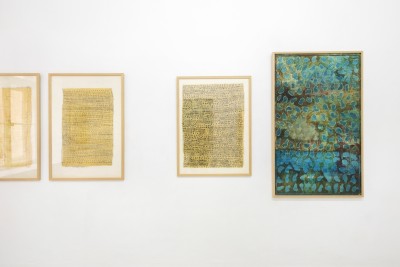
Perhaps, then, we should turn solely to the works themselves, carefully preserved over the years by her mother in a Warsaw apartment? Or perhaps we should attempt to probe beneath the surface of her paintings, drawings, prints, and collages – Mikołajewska fluidly shifted between media. She most often worked with small, repeated, abstract motifs, assembling compositions from dense clusters of forms. Some resemble clouds, others stylised human figures or insect-like hybrids, while still others evoke the human heart. In several pieces she meticulously overlaid her drawings with successive strips of thin, transparent scotch tape, as if trying to protect or seal what she had drawn. She titled several of these works Runic Script, suggesting perhaps that she regarded them as a kind of legible narrative, provided the viewer knew the code. Over time, she extended these proliferating forms beyond the two-dimensional plane of the canvas, painting them on objects resembling rather abstract domestic furnishings – beds, carpets, seats. This seems to have been an important gesture, signalling the intertwining of everyday life and art. Then, abruptly, she shifted her idiom, producing representational drawings accompanied by text. One of these, entitled Depression Has Its Advantages, is especially striking, prompting us to look at her biography – but, in the absence of evidence, leaving us suspended in conjecture.
All these fragments – of works, of life – inevitably provoke questions: how might we attempt to construct artistic herstories? What authority do we have to reconstruct them, and to what end? The exhibition at the Arton Foundation encourages us to try to find answers to these questions, while simultaneously opening new ones, above all: what can Mikołajewska’s art offer and reveal to us today, having been literally hidden from view for nearly forty years?
Liliana Mikołajewska-Jansen (1955–1981) was born in Warsaw, where she began her studies at the Academy of Fine Arts in the autumn of 1974. In February the following year she left for Belgium. She studied painting for a year at the Royal Academy of Fine Arts in Antwerp, and from 1976 sculpture at the Academy of Fine Arts in Berchem, while also working extensively in her own studio. In 1977 she enrolled at the Academy of Fine Arts in Ghent, where she graduated in 1980. During her lifetime she held only one solo exhibition, in Schoonaarde. Posthumously, in 1981, she was awarded the first Prize in the Competition for Young Belgian Painters, and her works were presented at the Palace of Fine Arts in Brussels. Subsequently, they were exhibited at the Muzeum Sztuki in Łódź (1984) and CBWA Zachęta in Warsaw (1985–1986).
Subsidized by the Ministry of Culture and National Heritage from the Fund for Promotion of Culture
Co-financed by the City of Warsaw
Arton Foundation
Foksal 11/4, Warsaw
19 September–16 November 2025
Opening: 19 September 2025, 7 p.m.
Curator: Marika Kuźmicz
Collaboration: Adam Parol
Film tour of the exhibition╰┈➤
Guided tour: 17 October 2025, 6 p.m.
We do not really know in what, or out of what, Liliana Mikołajewska’s works grew. The title of this exhibition – the first in nearly four decades – is inspired by one of her series of graphic works. Beyond that, she seldom titled her pieces. She left behind no written reflections; no interviews were conducted with her, or at least none survive. She died at an age when, for most artists, the journey has only just begun. The works she created during her student years constitute her entire oeuvre, and it is from these alone that we may attempt to decipher her intentions, inspirations, and creative impulses. Her biography is brief. She married early, began her studies at the Academy of Fine Arts in Warsaw, and interrupted them soon afterwards when she left Poland for Belgium in 1975. There she resumed her education, ultimately graduating from the Academy of Fine Arts in Ghent in 1980. Her life was cut short in a car accident.
What more can we say? With a high degree of certainty, she was determined to create and to pursue an original artistic path. This is evidenced both by the number of her works and by her persistence in continuing her studies under challenging circumstances: in a foreign country, in a foreign language, and in a world still divided by the Iron Curtain. In a sense, this makes the task of preparing her exhibition easier – we may assume she would have wanted her works to be seen again. Following Mikołajewska’s tragic death, only two major exhibitions of her oeuvre were held, presenting virtually her entire output. Importantly, they took place in two of the most important Polish institutions for contemporary art at the time: the CBWA Zachęta in Warsaw and Muzeum Sztuki in Łódź. Thereafter, her works disappeared from public view. The catalogue accompanying the Zachęta exhibition, although impressive in form, contains very little beyond reproductions of her works, a brief biography, and a memoir by her husband, Peter Jansen, who himself died tragically only a few years later. Other members of her family, who might have remembered her and spoken about her working process, her aspirations, and her inspirations, are also gone. What remains are the recollections of her school friends in Warsaw or her lecturer Wim Van Mulders – precious, though often shaped by emotion, impression, and subjective memory, and therefore not always easy to verify.
Perhaps, then, we should turn solely to the works themselves, carefully preserved over the years by her mother in a Warsaw apartment? Or perhaps we should attempt to probe beneath the surface of her paintings, drawings, prints, and collages – Mikołajewska fluidly shifted between media. She most often worked with small, repeated, abstract motifs, assembling compositions from dense clusters of forms. Some resemble clouds, others stylised human figures or insect-like hybrids, while still others evoke the human heart. In several pieces she meticulously overlaid her drawings with successive strips of thin, transparent scotch tape, as if trying to protect or seal what she had drawn. She titled several of these works Runic Script, suggesting perhaps that she regarded them as a kind of legible narrative, provided the viewer knew the code. Over time, she extended these proliferating forms beyond the two-dimensional plane of the canvas, painting them on objects resembling rather abstract domestic furnishings – beds, carpets, seats. This seems to have been an important gesture, signalling the intertwining of everyday life and art. Then, abruptly, she shifted her idiom, producing representational drawings accompanied by text. One of these, entitled Depression Has Its Advantages, is especially striking, prompting us to look at her biography – but, in the absence of evidence, leaving us suspended in conjecture.
All these fragments – of works, of life – inevitably provoke questions: how might we attempt to construct artistic herstories? What authority do we have to reconstruct them, and to what end? The exhibition at the Arton Foundation encourages us to try to find answers to these questions, while simultaneously opening new ones, above all: what can Mikołajewska’s art offer and reveal to us today, having been literally hidden from view for nearly forty years?
Liliana Mikołajewska-Jansen (1955–1981) was born in Warsaw, where she began her studies at the Academy of Fine Arts in the autumn of 1974. In February the following year she left for Belgium. She studied painting for a year at the Royal Academy of Fine Arts in Antwerp, and from 1976 sculpture at the Academy of Fine Arts in Berchem, while also working extensively in her own studio. In 1977 she enrolled at the Academy of Fine Arts in Ghent, where she graduated in 1980. During her lifetime she held only one solo exhibition, in Schoonaarde. Posthumously, in 1981, she was awarded the first Prize in the Competition for Young Belgian Painters, and her works were presented at the Palace of Fine Arts in Brussels. Subsequently, they were exhibited at the Muzeum Sztuki in Łódź (1984) and CBWA Zachęta in Warsaw (1985–1986).
Subsidized by the Ministry of Culture and National Heritage from the Fund for Promotion of Culture
Co-financed by the City of Warsaw
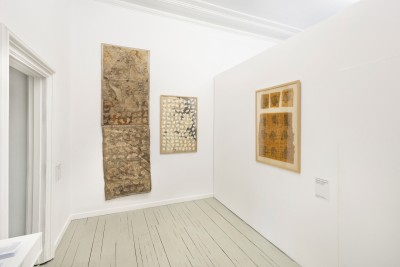
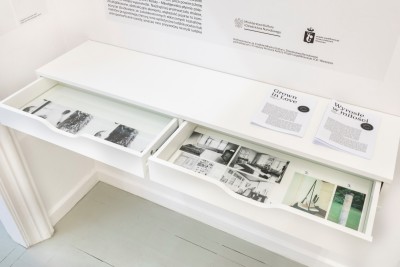
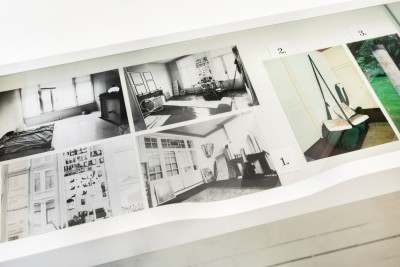
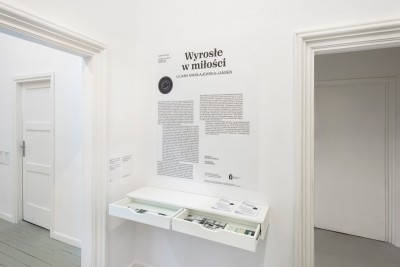
View of the exhibition "Grown in Love: Liliana Mikołajewska-Jansen"
Alexander Kot-Zaitsaŭ
Other exhibitions
-
 exhibitions
Natural Situations: Agnieszka Niziurska
-
 exhibitions
Parts. Zofia Glazer-Rudzińska
-
 exhibitions
Social History. 70 years of the gallery at Rynek Starego Miasta 2
-
 exhibitions
70th Anniversary of the Gallery at the Old Town Cultural Centre
-
 exhibitions
Such Was My Dream. Joanna Stańko
-
 exhibitions
Barbara Maroń. A Story Within a Story
-
 exhibitions
Applied Herstories: Irena Huml
-
 exhibitions
Mirrors and Screens: Małgorzata Potocka, Jagoda Kaloper
-
 exhibitions
Places for Deliberation. Barbara Kozłowska
-
 exhibitions
Małgorzata Rittersschild. The Lizard Means Short-Lived Happiness
-
 exhibitions
Beyond Documentation Imaginations Emerge. Anna and Krystian Jarnuszkiewicz
-
 exhibitions
Presence. Maria Michałowska
-
 exhibitions
Argentine Experiment: CAyC and CSSR
-
 exhibitions
Jolanta Owidzka. I Wouldn’t Dare Walk on a Work of Art
-
 exhibitions
Open Jagoda Przybylak Studio
-
 exhibitions
Jagoda Przybylak: "... must see"
-
 exhibitions
Maria Michałowska: At the End of This Road I Might Find a Mirror exhibition
-
 exhibitions
Looking Into The Sun. Hanna Orzechowska
-
 exhibitions
Motifs: Krystyna Szczepanowska-Miklaszewska
-
 exhibitions
You Will Hear When You See Me
-
 exhibitions
Jagoda Przybylak: “... must see”
-
 exhibitions
Ties and Threads: Herstories of Eleonora Plutyńska
-
 exhibitions
The less work, the better effect. Liliana Lewicka
-
 exhibitions
Anna Buczkowska
-
 exhibitions
Wspólny splot
-
 exhibitions
Hanna Orzechowska. W relacji / In relation
-
 exhibitions
wystawa Pawła Kwieka "Zrobić niemożliwe światło"
-
 exhibitions
Małgorzata Potocka
-
 exhibitions
P.S. Warunkiem uczestnictwa jest praca twórcza. Mikrohistorie plenerow w Osiekach
-
 exhibitions
Who is Janina Węgrzynowska?
-
 exhibitions
Anna Ciba: When You Look Into My Eyes, What Do You See?
-
 exhibitions
Małgorzata Potocka. We Don’t Need Other Words When We Have Mirrors
-
 exhibitions
Zdzisław Jurkiewicz. Sun in the Kitchen
-
 exhibitions
CLICK. Sexualisation of Food in Art
-
 exhibitions
Andrij Bojarov / Андрій Бояров: Koło i kula / Коло і куля
-
 exhibitions
Tapta
-
 exhibitions
Sisters: Alicja & Bożena Wahl
-
 exhibitions
Zdzisław Jurkiewicz. Occurrences
-
 exhibitions
Three Things I Love in Life: the Car, Liquor, and Sailors
-
 exhibitions
Phony Smile. Language of Aesthetic Speculation in Croatian Photography
-
 exhibitions
Exhibition Laboratory of Presentation Techniques
-
 exhibitions
Barbara Kozłowska. Linia
-
 exhibitions
Barbara Kozłowska. You Can See It All Anywhere
-
 exhibitions
Soft shooting? Introducing the History of Women’s Photography in Croatia
-
 exhibitions
Out in the Fresh Air? Early Ecological Projects during Artistic Plein-Airs in Poland
-
 exhibitions
At The Worlds Table. Zdzisław Jurkiewicz
-
 exhibitions
The Case of Jadwiga S.
-
 exhibitions
IN. Ludmiła Popiel i Jerzy Fedorowicz
-
 exhibitions
Womens Art, Iwona Lemke-Konart
-
 exhibitions
Paweł Kwiek. Time Difference
-
 exhibitions
Formy nikłe. Ludmiła Popiel & Jerzy Fedorowicz
-
 exhibitions
Nie mów, że urodziłeś się w złym czasie
-
 exhibitions
1: 11 Microstories
-
 exhibitions
I lay and fly away
-
 exhibitions
Wystawa Jolanty Marcolli w BWA Zielona Góra
-
 exhibitions
Ja to ktoś inny / Bruce Nauman / Krzysztof Niemczyk
-
 exhibitions
Video Killed The TV Star
-
 exhibitions
If you dont know me by now, you will never never never know me
-
 exhibitions
Arton Review Europe - exhibition and film screening
-
 exhibitions
Ludmiła Popiel
-
 exhibitions
Doing the Impossible Light
-
 exhibitions
Jolanta Marcolla. A Room of One’s Own
-
 exhibitions
across realities Wojciech Bruszewski / Mateusz Sadowski
-
 exhibitions
Andrzej Jórczak. Looking at Alpha Ursae
-
 exhibitions
6 meters before Paris - Eustachy Kossakowski
-
 exhibitions
Polska Fotografia Konceptualna
-
 exhibitions
Conceptualism. Photographic medium.
-
 exhibitions
Barbara Kozłowska Wszystko to możesz zobaczyć gdziekolwiek
-
 exhibitions
Zdarzenia. Zdzisław Jurkiewicz