exhibitions
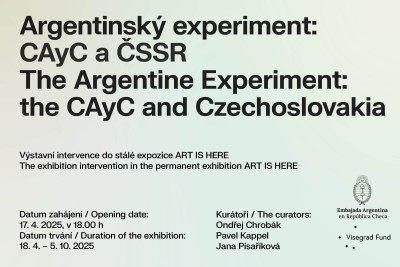
Argentine Experiment: CAyC and CSSR
On April 17, 2025, at 6 pm, we invite you to the opening of the exhibition "Argentine Experiment: CAyC and CSSR", which will be held at the Moravian Gallery in Brno (Husova 18, Brno, Czech Republic)
Curators: Ondřej Chrobák, Pavel Kappel, Jana Písaříková
For more information: https://moravska-galerie.cz/vystavy/vystavni-intervence-ve-stale-expozici-argentinsky-experiment-cayc-a-cssr/
In 1968, artist, theorist and entrepreneur Jorge Glusberg founded the progressive institution Centro de Arte y Comunicación (CAyC) in Buenos Aires. The innovative “geopolitical” aspect of CAyC's activities was the collaboration he undertook not only with entities in the West, but also with Eastern Bloc countries - in particular Czechoslovakia, Hungary and Poland - as well as with “autonomous” Yugoslavia. Jorge Glusberg had an ambitious plan to create an artistic network that would connect Eastern Europe and the global South, and that would counterbalance the dominant narrative of Western art.
In the Czechoslovak context, he made contact with Professor Pavel Štěpánek, a university graduate and assistant at the National Gallery. Glusberg's other contact was Jiří Valoch, whose work in the field of visual poetry was exhibited at international exhibitions of experimental poetry around the world, including Argentina (La Exposición Internacional de Novísima Poesía/69). In 1971, a number of Czechoslovak artists participated in the Arte de Sistemas exhibition, which included not only local Argentine neo-avant-garde artists, but also a related international art community
The exhibition will present a collection of graphic folios by Argentine authors working within the CAyC, which were exhibited in 1971 by Prof. Štěpánek in the exhibition “Argentine Constructivism” at the Benedikt Rejt Gallery. There will also be a “symbolic” reconstruction of a Czechoslovakian work for the exhibition "Arte de Sistemas" developed from a collection of materials and artworks related to CAyC. The communication between CAyC and individual and local art scenes is one of the most interesting phenomena in the field of international relations of the post-war art world.
The project is co-financed by the governments of the Czech Republic, Hungary, Poland and Slovakia through Visegrad Grants from the International Visegrad Fund. The fund's mission is to promote the idea of sustainable regional cooperation in Central Europe.
Curators: Ondřej Chrobák, Pavel Kappel, Jana Písaříková
For more information: https://moravska-galerie.cz/vystavy/vystavni-intervence-ve-stale-expozici-argentinsky-experiment-cayc-a-cssr/
In 1968, artist, theorist and entrepreneur Jorge Glusberg founded the progressive institution Centro de Arte y Comunicación (CAyC) in Buenos Aires. The innovative “geopolitical” aspect of CAyC's activities was the collaboration he undertook not only with entities in the West, but also with Eastern Bloc countries - in particular Czechoslovakia, Hungary and Poland - as well as with “autonomous” Yugoslavia. Jorge Glusberg had an ambitious plan to create an artistic network that would connect Eastern Europe and the global South, and that would counterbalance the dominant narrative of Western art.
In the Czechoslovak context, he made contact with Professor Pavel Štěpánek, a university graduate and assistant at the National Gallery. Glusberg's other contact was Jiří Valoch, whose work in the field of visual poetry was exhibited at international exhibitions of experimental poetry around the world, including Argentina (La Exposición Internacional de Novísima Poesía/69). In 1971, a number of Czechoslovak artists participated in the Arte de Sistemas exhibition, which included not only local Argentine neo-avant-garde artists, but also a related international art community
The exhibition will present a collection of graphic folios by Argentine authors working within the CAyC, which were exhibited in 1971 by Prof. Štěpánek in the exhibition “Argentine Constructivism” at the Benedikt Rejt Gallery. There will also be a “symbolic” reconstruction of a Czechoslovakian work for the exhibition "Arte de Sistemas" developed from a collection of materials and artworks related to CAyC. The communication between CAyC and individual and local art scenes is one of the most interesting phenomena in the field of international relations of the post-war art world.
The project is co-financed by the governments of the Czech Republic, Hungary, Poland and Slovakia through Visegrad Grants from the International Visegrad Fund. The fund's mission is to promote the idea of sustainable regional cooperation in Central Europe.
Other exhibitions
-
 exhibitions
Natural Situations: Agnieszka Niziurska
-
 exhibitions
Parts. Zofia Glazer-Rudzińska
-
 exhibitions
Social History. 70 years of the gallery at Rynek Starego Miasta 2
-
 exhibitions
70th Anniversary of the Gallery at the Old Town Cultural Centre
-
 exhibitions
Such Was My Dream. Joanna Stańko
-
 exhibitions
Barbara Maroń. A Story Within a Story
-
 exhibitions
Applied Herstories: Irena Huml
-
 exhibitions
Grown in Love: Liliana Mikołajewska-Jansen
-
 exhibitions
Mirrors and Screens: Małgorzata Potocka, Jagoda Kaloper
-
 exhibitions
Places for Deliberation. Barbara Kozłowska
-
 exhibitions
Małgorzata Rittersschild. The Lizard Means Short-Lived Happiness
-
 exhibitions
Beyond Documentation Imaginations Emerge. Anna and Krystian Jarnuszkiewicz
-
 exhibitions
Presence. Maria Michałowska
-
 exhibitions
Jolanta Owidzka. I Wouldn’t Dare Walk on a Work of Art
-
 exhibitions
Open Jagoda Przybylak Studio
-
 exhibitions
Jagoda Przybylak: "... must see"
-
 exhibitions
Maria Michałowska: At the End of This Road I Might Find a Mirror exhibition
-
 exhibitions
Looking Into The Sun. Hanna Orzechowska
-
 exhibitions
Motifs: Krystyna Szczepanowska-Miklaszewska
-
 exhibitions
You Will Hear When You See Me
-
 exhibitions
Jagoda Przybylak: “... must see”
-
 exhibitions
Ties and Threads: Herstories of Eleonora Plutyńska
-
 exhibitions
The less work, the better effect. Liliana Lewicka
-
 exhibitions
Anna Buczkowska
-
 exhibitions
Wspólny splot
-
 exhibitions
Hanna Orzechowska. W relacji / In relation
-
 exhibitions
wystawa Pawła Kwieka "Zrobić niemożliwe światło"
-
 exhibitions
Małgorzata Potocka
-
 exhibitions
P.S. Warunkiem uczestnictwa jest praca twórcza. Mikrohistorie plenerow w Osiekach
-
 exhibitions
Who is Janina Węgrzynowska?
-
 exhibitions
Anna Ciba: When You Look Into My Eyes, What Do You See?
-
 exhibitions
Małgorzata Potocka. We Don’t Need Other Words When We Have Mirrors
-
 exhibitions
Zdzisław Jurkiewicz. Sun in the Kitchen
-
 exhibitions
CLICK. Sexualisation of Food in Art
-
 exhibitions
Andrij Bojarov / Андрій Бояров: Koło i kula / Коло і куля
-
 exhibitions
Tapta
-
 exhibitions
Sisters: Alicja & Bożena Wahl
-
 exhibitions
Zdzisław Jurkiewicz. Occurrences
-
 exhibitions
Three Things I Love in Life: the Car, Liquor, and Sailors
-
 exhibitions
Phony Smile. Language of Aesthetic Speculation in Croatian Photography
-
 exhibitions
Exhibition Laboratory of Presentation Techniques
-
 exhibitions
Barbara Kozłowska. Linia
-
 exhibitions
Barbara Kozłowska. You Can See It All Anywhere
-
 exhibitions
Soft shooting? Introducing the History of Women’s Photography in Croatia
-
 exhibitions
Out in the Fresh Air? Early Ecological Projects during Artistic Plein-Airs in Poland
-
 exhibitions
At The Worlds Table. Zdzisław Jurkiewicz
-
 exhibitions
The Case of Jadwiga S.
-
 exhibitions
IN. Ludmiła Popiel i Jerzy Fedorowicz
-
 exhibitions
Womens Art, Iwona Lemke-Konart
-
 exhibitions
Paweł Kwiek. Time Difference
-
 exhibitions
Formy nikłe. Ludmiła Popiel & Jerzy Fedorowicz
-
 exhibitions
Nie mów, że urodziłeś się w złym czasie
-
 exhibitions
1: 11 Microstories
-
 exhibitions
I lay and fly away
-
 exhibitions
Wystawa Jolanty Marcolli w BWA Zielona Góra
-
 exhibitions
Ja to ktoś inny / Bruce Nauman / Krzysztof Niemczyk
-
 exhibitions
Video Killed The TV Star
-
 exhibitions
If you dont know me by now, you will never never never know me
-
 exhibitions
Arton Review Europe - exhibition and film screening
-
 exhibitions
Ludmiła Popiel
-
 exhibitions
Doing the Impossible Light
-
 exhibitions
Jolanta Marcolla. A Room of One’s Own
-
 exhibitions
across realities Wojciech Bruszewski / Mateusz Sadowski
-
 exhibitions
Andrzej Jórczak. Looking at Alpha Ursae
-
 exhibitions
6 meters before Paris - Eustachy Kossakowski
-
 exhibitions
Polska Fotografia Konceptualna
-
 exhibitions
Conceptualism. Photographic medium.
-
 exhibitions
Barbara Kozłowska Wszystko to możesz zobaczyć gdziekolwiek
-
 exhibitions
Zdarzenia. Zdzisław Jurkiewicz